Florida Funders Launches ‘Florida First Check’ To Target Critical Gap in the State’s Startup Funding Ecosystem
Florida has spent years building the pieces of a thriving innovation economy: world-class universities, growing technology hubs, successful entrepreneurs, accelerators, angel networks and an expanding venture capital community.
But one stubborn challenge remains. Who writes the first check?
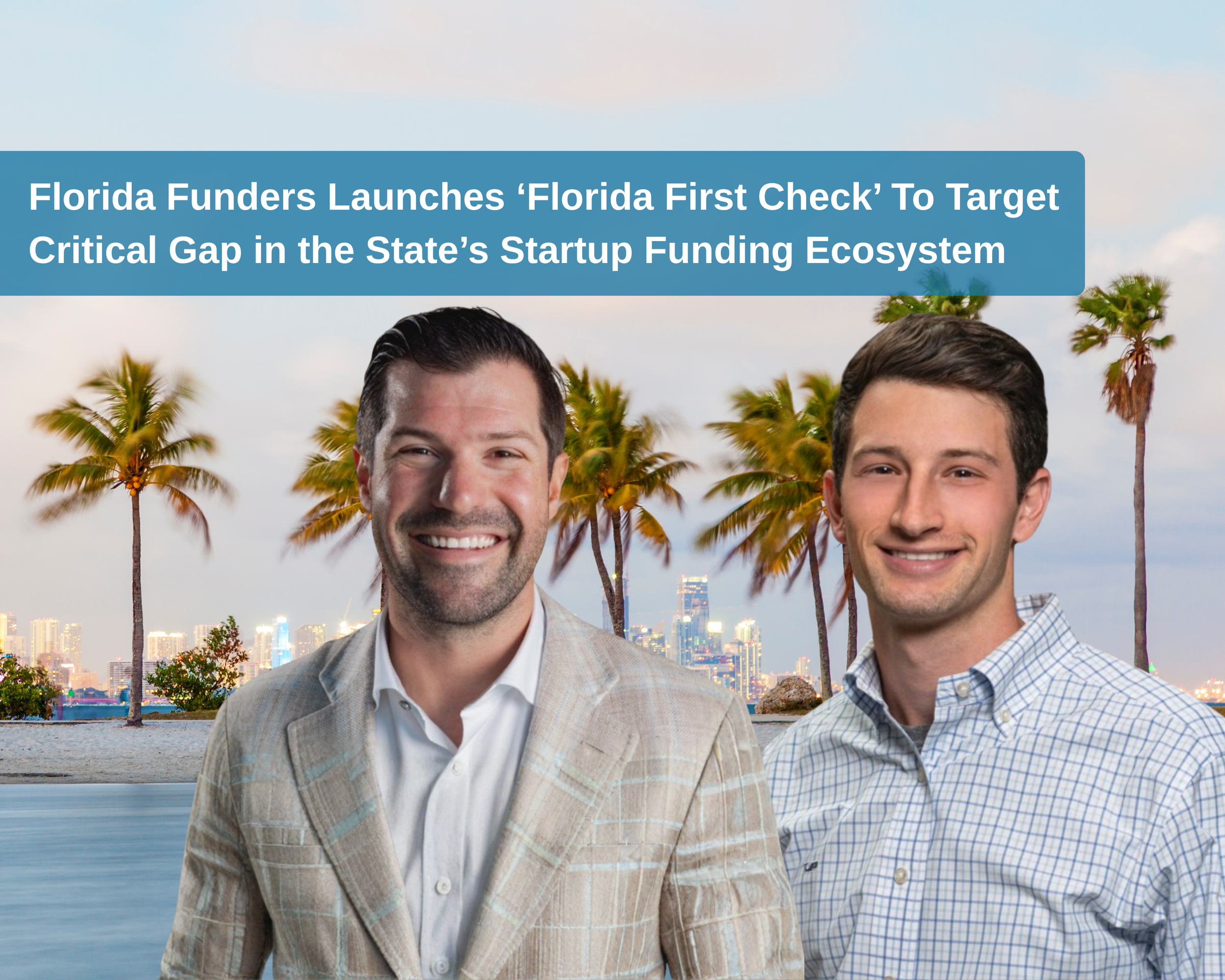
The Florida Institute for the Commercialization of Florida Technology, in partnership with Florida Funders, has launched Florida First Check, a new pre-seed investment strategy providing early-stage Florida technology companies with investments ranging from $75,000 to $100,000.
The initiative targets a particularly difficult point in a startup’s lifecycle: the period when a founder may have promising technology and early validation but is still too early for many traditional venture capital investors.
For Florida, closing that gap could have implications well beyond the companies receiving the money.
Addressing Florida’s “First Check” Problem
Florida's startup ecosystem has grown considerably over the past decade.
The Miami Metro region has emerged as an international technology and investment destination. The Greater Tampa Bay area has developed a growing community of technology companies and investors. Greater Orlando continues to build around simulation, defense, aerospace and other emerging technologies. Across the state, universities, healthcare systems and research institutions are generating new opportunities in areas ranging from artificial intelligence and cybersecurity to biotechnology and quantum computing.
Yet access to the earliest stages of capital remains challenging.
Promising founders often need relatively modest amounts of funding to turn research or intellectual property into a commercial company, hire their first employees, build a minimum viable product or demonstrate early customer traction.
Those milestones can make a company significantly more attractive to angel investors and venture funds. But someone still has to go first. Florida First Check was created specifically for that moment.
Under the program, the Florida Institute provides the investment capital, while Florida Funders will source potential companies, conduct diligence, select investments and deploy the capital. The result creates a new pathway for Florida startups to receive an institutional investment earlier in their development.
More Than a $100,000 Investment
While $75,000 to $100,000 may appear relatively small compared with multimillion-dollar venture rounds, the significance of the program could extend beyond the size of the initial investment. An institutional first check can provide something young companies desperately need: validation.
A company that has successfully completed an institutional diligence process may be better positioned when approaching angel investors, venture firms and other sources of follow-on capital.
Florida First Check also connects participating entrepreneurs with broader resources, including executive networks, company-building support and relationships throughout Florida's university and research ecosystem.
In that sense, the initiative isn't simply intended to provide capital. It is designed to help companies reach the next investable milestone.
An Evergreen Approach to Startup Investment
Another notable element of Florida First Check is its structure. Rather than operating solely as a traditional fixed-life investment fund, Florida First Check is being developed as an evergreen investment strategy.
As investments generate returns, proceeds can potentially be reinvested into future Florida startups. That creates the possibility of a continually replenishing source of early-stage capital.
If successful, today's investment in one Florida startup could ultimately help finance the next generation of companies emerging across the state. That model also shifts the conversation around economic development.
Instead of viewing startup support strictly as an expense, Florida First Check treats early-stage innovation as an asset capable of generating returns that can be recycled back into the ecosystem.
Florida's Venture Numbers Don't Tell the Whole Story
At first glance, Florida's recent entrepreneurial and venture capital numbers might suggest the state doesn't have much of a startup funding problem.
According to the Kauffman Indicators of Entrepreneurship, Florida had the highest rate of new entrepreneurs in the country in 2025 and at 0.57%, nearly twice the state median of 0.29%. Florida also ranked first nationally on Kauffman's overall Early-Stage Entrepreneurship Index. Venture investment has grown alongside that entrepreneurial activity.
According to the eMerge Americas 2025 Florida Venture Capital Insights Report, Florida startups attracted $5.83 billion across 575 venture deals in 2025, ranking the state fifth nationally by number of venture deals and seventh by deal value. South Florida accounted for an outsized share of that investment.
Using information compiled by PitchBook, CB Insights, and Crunchbase, companies from Miami-Dade through Palm Beach County attracted approximately $4.13 billion across 376 venture deals, representing roughly 65% of Florida's venture deals and 71% of the state's venture dollars.
Those numbers represent significant progress for Florida's innovation economy. But they don't necessarily reveal what happens at the very beginning of the funding pipeline. A startup raising a multimillion-dollar Series A or Series B occupies a very different investment market than a founder looking for the first $100,000 needed to commercialize technology, develop a product, hire an initial employee or demonstrate market demand.
Once a company has customers, revenue, an established team and measurable growth, investors in New York, Silicon Valley, Boston or elsewhere can more easily evaluate the opportunity. Before those milestones exist, the risk is significantly greater. That creates a difficult paradox for early-stage founders: investors often want evidence that a company can succeed, while founders need capital to generate that evidence.
There is another notable disconnect in South Florida's recent venture numbers. While South Florida companies attracted $4.13 billion in venture investment in 2025, fundraising by South Florida-based venture funds totaled only about $300 million, the lowest annual total in eight years, according to an analysis of PitchBook data.
There are signs of improvement. During the first half of 2026, 14 South Florida-based investment funds had already raised more than $300 million, approximately matching the region's total for all of 2025. Even so, local fund formation remained below levels reached during much of the 2019–2024 period. That distinction matters.
Money invested into Florida companies isn't necessarily the same thing as investment capital controlled within Florida's ecosystem.
Outside investment flowing into Florida should be viewed as an economic-development success. When an investment firm elsewhere puts millions into a Florida-headquartered company that hires employees and expands operations here, Florida is effectively importing investment capital.
But attracting capital to companies that have already demonstrated significant traction isn't the same as having sufficient locally accessible capital available at the very beginning. That is the part of Florida's capital continuum Florida First Check is attempting to strengthen.
Keeping Florida Companies in Florida
There is also a larger economic-development objective behind the initiative. Florida clearly doesn't have a shortage of entrepreneurs or ideas. The challenge is ensuring promising companies can find the resources they need to grow without having to leave the state.
“Florida has no shortage of brilliant founders — what's been missing is a reliable first check that keeps them building here instead of relocating for capital,” said Rafael Lohner, Executive Director of The Florida Institute. “Partnering with Florida Funders to manage Florida First Check gives our state's earliest-stage companies an institutional partner from day one. And when a company builds here, the high-wage jobs and economic impact it creates stay here — that's the Institute's mission at work.”
When founders must look elsewhere for their earliest investors, those relationships can eventually influence where companies establish headquarters, recruit employees, build executive teams and raise subsequent rounds of capital.
Writing the first institutional check locally gives Florida an opportunity to establish those relationships earlier. The potential impact isn't simply retaining an individual founder.
Successful startups create jobs, attract outside investment, generate intellectual property, recruit talent and often produce experienced founders and executives who eventually invest in or launch additional companies.
Keeping more of that cycle inside Florida strengthens the state's innovation economy over time.
The First Investment Is Already Underway
Florida First Check has already moved beyond announcement into deployment. The initiative's inaugural investment is Stello AI, a Tampa-based artificial intelligence company.
That first investment represents the beginning of what could eventually become a much broader pipeline of companies sourced from communities throughout Florida. And that statewide approach may prove to be one of the initiative's most important characteristics.
“Building Stello AI in Florida has been a huge advantage — the community is very open to innovation and has a deep appreciation for AI,” said Amee Parekh, Co-Founder and CEO of Stello AI. “Having Florida Funders and Florida First Check as our first institutional partner means we get more than capital — we get a team that's as committed to our success and willing to partner with us on our bold, ambitious bets.”
That statewide approach may prove to be one of the initiative's most important characteristics. Florida's innovation economy has historically developed through strong but sometimes disconnected regional ecosystems. Miami, Fort Lauderdale, Palm Beach, Tampa, Orlando, Jacksonville, Gainesville and other communities each have their own universities, accelerators, investors, economic-development organizations and entrepreneur networks.
A statewide investment strategy creates an opportunity to connect those pipelines and identify promising companies regardless of where in Florida they emerge.
Building Florida's Capital Continuum
The long-term importance of Florida First Check may ultimately depend on what happens after the first check. A healthy startup economy requires a continuum of capital.
A founder might begin with personal investment or support from friends and family, move into pre-seed funding, raise from angel investors, secure an institutional seed round and eventually access larger venture and growth capital. When one piece of that continuum is missing, promising companies can stall.
Florida First Check is attempting to strengthen the very beginning of that pipeline. The opportunity now is for Florida's universities, incubators, accelerators, economic-development organizations, angel groups and venture investors to connect around it.
Those organizations can help identify promising founders. Florida First Check can provide early institutional capital. Angel investors and seed funds can provide the next round. Larger venture firms can provide growth capital. Together, those pieces could create a more connected pathway for building and scaling technology companies without leaving Florida.
Companies that successfully scale create jobs and attract additional investment. Their employees gain startup experience. Successful founders become mentors and, in many cases, angel investors themselves. Capital and experience from one generation of companies can then help finance the next.
That is how an entrepreneurial ecosystem begins to become self-sustaining.
A Small Check With a Potentially Big Impact
Florida First Check won't solve Florida's early-stage capital challenge by itself. No single program can. But its launch represents an important acknowledgment of where one of the state's most persistent funding gaps exists.
Florida has built an extraordinary entrepreneurial engine. It leads the nation in the rate of new entrepreneurship, its startups are attracting billions of dollars in venture investment, and South Florida alone has developed into one of the country's most active venture markets.
The next challenge is ensuring that promising companies have enough capital at the beginning of their journeys to eventually become the companies capable of attracting those larger investments.
That means connecting Florida's universities, entrepreneurs, accelerators and research institutions to a deeper continuum of capital, from the first institutional investment through seed, venture and growth funding.
Sometimes that journey eventually requires millions of dollars. But long before the multimillion-dollar round, the national venture firm or the headline-making exit, someone has to be willing to take the earliest risk. Someone has to go first.
“If you're an accelerator, incubator, or university program in Florida that we're not already working with, we want to hear from you — reach out to us at FirstCheck@floridafunders.com,” said Saxon Baum, Managing Partner at Florida Funders. “And if you're a pre-seed founder who fits this profile, let us know. We want to work with the best builders in this state.”
Florida First Check is betting that more of those first checks should be written right here in Florida.

Miami-based TrustedRouter has raised $1.25 million in seed funding as demand grows for infrastructure connecting businesses with multiple AI models. The startup provides access to more than 600 models across over 81 providers while helping users select models based on performance, cost, privacy, and reliability. TrustedRouter is also emphasizing confidential computing and open-source technology to protect sensitive customer data. The funding adds another AI infrastructure startup to South Florida’s growing technology ecosystem.