

Fort Lauderdale's Upside Raises $20 Million to Address One of Healthcare's Biggest Challenges: Housing
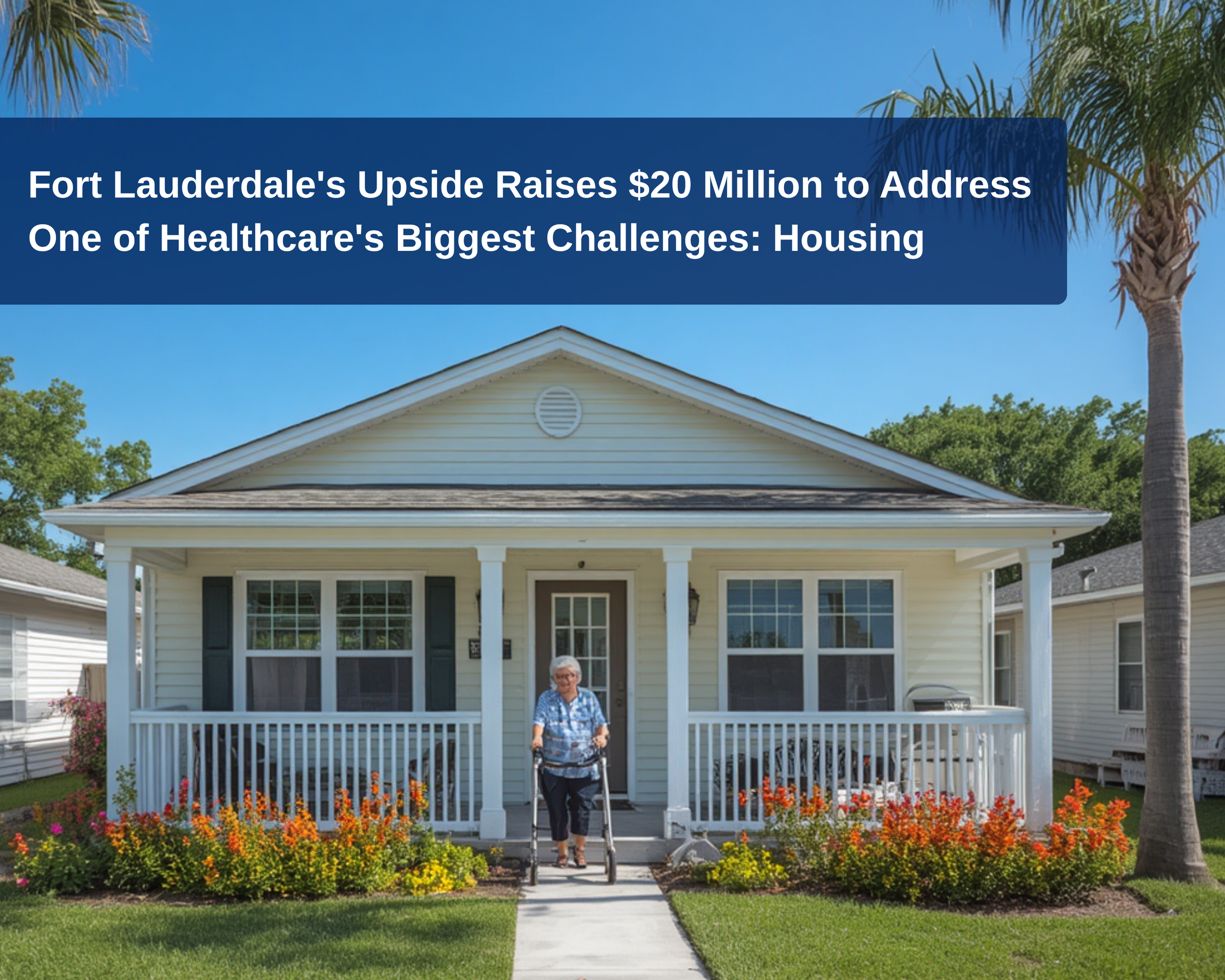
"Housing instability is one of the most persistent drivers of avoidable healthcare spend." That was the investment thesis behind Fort Lauderdale-based Upside's $20 million Series A financing, announced this week, positioning the company for rapid national expansion.
The investment was co-led by Aquiline and Flare Capital Partners, with continued participation from existing investors 645 Ventures, Freestyle Capital, Triple Impact Capital, and Techstars.
For many startups, a Series A represents validation of a product. For Upside, it's validation of a much larger idea: that housing stability should be viewed as an essential component of healthcare.
Solving a Healthcare Problem That Starts Outside the Hospital
Housing insecurity has long been recognized as one of the most significant social determinants of health. Individuals without stable housing often experience higher emergency room utilization, increased hospitalizations, poorer chronic disease management, and greater overall healthcare costs.
Upside was built to address that challenge.
The company partners with health plans, employers, healthcare providers, and community organizations to identify members experiencing housing instability and connect them with affordable housing resources before those challenges escalate into medical crises.
Using a combination of AI-powered technology, proprietary housing data, and dedicated Care Guides, Upside helps individuals navigate one of the most complex systems they may ever face while simultaneously helping healthcare organizations improve outcomes and reduce unnecessary costs.
Rather than treating housing as someone else's responsibility, Upside integrates it directly into healthcare delivery.
A Mission That Continues to Grow
For founder Peter Bagley, the announcement isn't simply about raising capital, it's about expanding impact. "This funding allows us to accelerate a mission that feels more urgent than ever: helping people find and maintain stable housing when housing instability is putting their health, well-being and future at risk," Bagley shared when announcing the raise.
After working alongside health plans, employers, providers, and community organizations across the country, Bagley says one lesson has become increasingly clear. "Housing isn't just a social issue. It's a healthcare issue, an economic issue and a human issue."
That philosophy reflects a broader shift occurring throughout healthcare as insurers and providers increasingly invest in addressing social determinants of health rather than focusing exclusively on clinical care.
Bagley also credited the company's investors for helping shape this next phase of growth, thanking Avery Dean Klinger and the Aquiline team for encouraging Upside to "think bigger," while recognizing Dr. Dan Gebremedhin, and the Flare Capital team for their partnership and conviction in the company's long-term vision.
Despite the financing milestone, Bagley emphasized that the company's greatest accomplishment remains its people.
"What makes me most proud isn't the capital we've raised. It's the team we've built. Every day, they help individuals and families navigate some of the most difficult moments in their lives and create real, measurable outcomes."
How the Funding Will Be Used
The new capital will enable Upside to accelerate growth across several strategic areas.
The company plans to expand partnerships with Medicaid and Medicare Advantage organizations while growing its presence among employer-sponsored health plans. Additional investment will support hiring across technology and care delivery teams, further development of its AI-enabled care coordination platform, and expansion into new markets across the United States.
The AI handles the repeatable work, surfacing housing options, summarizing cases, flagging risk, so Care Guides stay focused on the complex, relationship-driven work that actually drives outcomes.
"AI does not replace a Care Guide. It frees one up," said Peter Badgley, Co-Founder and COO of Upside. "When the repeatable work runs in the background, our team can do more of what only people can do, which is sit with someone in crisis and get them somewhere safe."
As healthcare organizations increasingly seek scalable solutions that improve both patient outcomes and financial performance, Upside is positioning itself to become a critical infrastructure partner rather than simply another digital health application.
Why This Market Is Taking Off
The healthcare industry is rapidly shifting toward value-based care, where providers and insurers are rewarded for improving long-term health outcomes rather than simply delivering more medical services. As a result, housing stability has become more than a community issue, it has become a strategic healthcare priority.
Organizations increasingly recognize that addressing housing insecurity can reduce avoidable emergency department visits, improve medication adherence, lower hospital readmissions, and ultimately reduce the total cost of care. That opportunity is what attracted Upside's newest investors.
"Housing instability is one of the most persistent drivers of avoidable healthcare spend," said Dante La Ruffa, Partner and Head of Aquiline's Venture & Growth Strategy. "Upside has the model, team, and infrastructure to address it, and we're excited to partner with the company in its next chapter."
La Ruffa added that Aquiline sees "significant opportunities to accelerate Upside's momentum through Aquiline's strategic connectivity across health plan, payer, and broker channels, as well as through product adjacencies that further expand the company's value proposition for all key stakeholders."
But investors also believe the broader Health Related Social Needs (HRSN) market is entering a new phase of maturity.
"The Health Related Social Needs solutions market is approaching the mid-innings of maturity," said Dr. Dan Gebremedhin, Partner at Flare Capital Partners. "The first wave saw companies find success with population-wide screening and solutions directories, but stopped short of driving or guaranteeing outcomes. What drew us to Upside was the rapid cycle time of referral to engagement to success in closing key needs gaps, starting with housing, in a matter of months."
Looking ahead, Flare sees additional opportunity to expand the platform through artificial intelligence and measurable healthcare outcomes.
"We look forward to partnering with the company to further deploy AI technologies to ensure this valuable service is cost-effective and can be deployed to more populations with proven medical and benefit design ROI," Gebremedhin said.
Together, the two investment firms highlight why Upside stands out in an increasingly competitive healthcare technology landscape. Rather than simply identifying social needs or connecting members with community resources, the company has built a model designed to produce measurable outcomes for patients while delivering financial value to health plans, providers, employers, and other stakeholders.
For investors, the opportunity extends well beyond housing. It represents the convergence of healthcare, artificial intelligence, care navigation, and social infrastructure, one of the fastest-growing areas of innovation in digital health. As healthcare organizations continue shifting toward preventive, value-based care, platforms capable of demonstrating both improved health outcomes and measurable return on investment are expected to play an increasingly important role in the industry's future.
What It Means for South Florida
Upside's $20 million Series A is about far more than one company's growth. It is another signal that South Florida's innovation ecosystem continues to mature, producing venture-backed companies capable of tackling some of the nation's most complex challenges in healthcare, artificial intelligence, life sciences, and enterprise technology.
While the region has earned national recognition for its momentum in fintech, cybersecurity, and financial services, healthcare innovation is rapidly emerging as another defining strength. Companies like Upside demonstrate that South Florida is not simply attracting entrepreneurs and investment, it's building businesses with the potential to reshape industries on a national scale.
The announcement also reflects a broader shift in how institutional investors view the region. Increasingly, firms are looking beyond South Florida as a destination for founders and recognizing it as a place where category-defining companies can launch, grow, and scale.
As healthcare continues its transition toward preventive, value-based care, solutions addressing housing, food security, transportation, and other social determinants of health will become increasingly central to improving outcomes while reducing costs. With fresh capital, experienced investors, and a mission aligned with one of healthcare's most pressing structural challenges, Upside is well positioned to help lead that transformation.
For South Florida, the company's latest milestone is more than a successful funding round. It is another example of the region producing innovative companies that are solving meaningful national problems, attracting institutional capital, and reinforcing South Florida's emergence as one of the country's fastest-growing centers for healthcare innovation.




Related Ross is expanding its Palm Beach County presence with Village Landing, a 71-acre mixed-use development planned for Wellington. The project will bring approximately 220,000 square feet of retail, more than 100,000 square feet of restaurants, 90,000 square feet of offices, and a 180-room hotel. Designed as a walkable town center, Village Landing will also feature plazas, green spaces, a village square, and a lakefront boardwalk. Construction is expected to begin in fall 2026 as Related Ross expands beyond its West Palm Beach base.