
HealthSnap Secures $25M to Scale AI-Powered Virtual Care as Major Health System Customers Become Investors
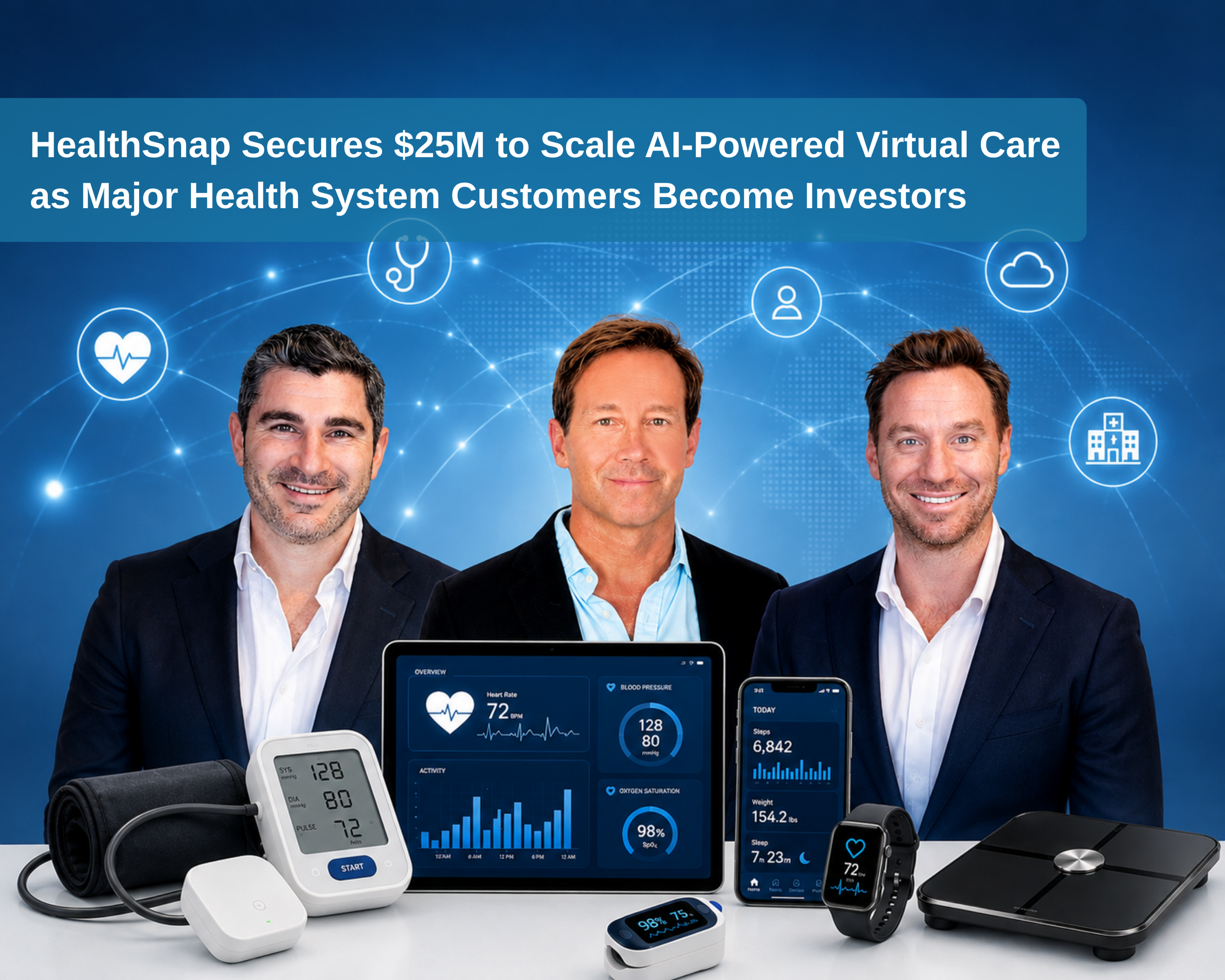
Miami-based HealthSnap has secured a $25 million senior secured growth financing facility as the healthcare technology company accelerates its expansion into AI-powered virtual care management.
The financing, led by Eastward Capital Partners, will strengthen HealthSnap’s balance sheet, refinance existing debt and provide additional growth capital to accelerate artificial intelligence innovation, expand commercial operations and scale deployment of its Advanced Primary Care Management (APCM) platform across major health systems.
The transaction represents a new chapter for a South Florida company that has grown considerably beyond its roots in remote patient monitoring.
Today, HealthSnap supports more than 80,000 active patient programs across 200 health systems and physician organizations nationwide. The company expects that figure to surpass 100,000 active patient programs by the end of 2026.
Its platform now ingests two patient measurements every second.
The company is increasingly positioning itself at the intersection of virtual care, artificial intelligence and a fundamental challenge facing healthcare organizations across the country: how to care for larger and increasingly complex patient populations without requiring an equivalent increase in clinical staff.
From Remote Monitoring to an AI-Powered Care Platform
Founded by Samson Magid, Chase Preston and Dr. Wesley Smith, HealthSnap initially made its mark in Remote Patient Monitoring, or RPM, enabling healthcare providers to continuously monitor patients with chronic conditions outside traditional clinical settings.
The company has since expanded substantially, bringing together Remote Patient Monitoring, Chronic Care Management, Principal Care Management, Advanced Primary Care Management, care coordination, reimbursement optimization, enterprise analytics and AI-powered clinical workflows within a single EMR-integrated platform.
Earlier this year, HealthSnap launched its AI-augmented APCM solution, combining agentic AI with clinical workflows designed to help healthcare teams manage larger patient populations more efficiently while maintaining personalized care.
“When we founded HealthSnap, we believed healthcare was moving toward a future where continuous, intelligent care would become the standard, not the exception,” said Samson Magid, co-founder and CEO of HealthSnap.
“Our vision has always been to use AI to amplify clinicians, not replace them, helping health systems improve outcomes, strengthen operational performance, and lower the total cost of care.”
That approach comes as hospitals and healthcare organizations grapple with clinician shortages, rising labor costs, aging populations and growing numbers of patients living with chronic conditions.
Putting AI to Work Inside Healthcare
HealthSnap is already deploying AI across several stages of care delivery. In 2025, the company says its platform reviewed more than 3 million clinical progress notes for quality assurance, compared with the roughly 1% to 2% sample that would traditionally undergo manual auditing.
The company also uses AI-powered patient simulations to prepare newly hired nurses before interacting with patients and AI-generated clinical summaries to transform complex care data into concise, actionable insights for clinicians.
HealthSnap is now expanding AI agents into routine patient interactions, including enrollment, device troubleshooting and compliance outreach, allowing care teams to focus their time on situations requiring human expertise and judgment.
The company says all AI-generated recommendations operate within clinician-defined protocols and safety guardrails, with physicians and care teams retaining final clinical judgment.
When Customers Become Investors
Perhaps one of the strongest signals of HealthSnap’s growing position in healthcare is not simply the number of organizations using its technology, but who those organizations are.
HealthSnap partners with major healthcare systems including Prisma Health, AdventHealth, Ascension Health, Sentara Health, Tampa General Hospital, UnityPoint Health, Baptist Health South Florida, Mount Sinai Medical Center and University Hospitals.
Several have gone a step further. Sentara Health, Tampa General HospitalandUnityPoint Health have also strategically invested in HealthSnap.
The investments provide another layer of validation for the company: healthcare organizations with firsthand experience deploying HealthSnap’s technology are now financially backing its growth. They also reinforce the company’s ties to Florida’s healthcare ecosystem.
Growth With an Eye on Financial Performance
Unlike a traditional venture capital raise, the new $25 million comes through a senior secured growth financing facility rather than a new equity funding round. HealthSnap was advised on the transaction by specialty investment bank Ziegler, which served as the company’s exclusive financial advisor.
The financing follows a period of substantial growth.
HealthSnap reports that revenue has increased more than fivefold over the past three years, representing more than 400% growth since June 2023. The company is also reporting 40% year-over-year revenue growth alongside a 47% year-over-year improvement in EBITDA.
“Healthcare is entering a new era where artificial intelligence, automation, and continuous patient engagement will fundamentally reshape care delivery,” said Ed Dresner, Investment Partner at Eastward Capital Partners.
Dresner pointed to HealthSnap’s enterprise adoption, measurable outcomes and financial performance as reasons for the investment, describing the company as demonstrating “disciplined financial performance while serving some of the country’s most sophisticated health systems.”
HealthSnap ranked No. 165 overall on the 2025 Inc. 5000 and No. 17 among the list’s fastest-growing Healthcare & Medical companies. It also received the 2025 MedTech Breakthrough Award for Best Clinical Efficiency Solution and has maintained HITRUST certification for four consecutive years.
Measuring What Happens Beyond the Screen
Beyond revenue and customer growth, HealthSnap points to clinical research examining whether remote patient monitoring can improve outcomes and lower healthcare costs.
In a 2024 peer-reviewed study of 6,595 patients published in Healthcare, researchers found that participation in remote patient monitoring was associated with a 7.3 mmHg improvement in systolic blood pressure across all patients and a 16.7 mmHg improvement among patients with Stage 2 hypertension.
According to HealthSnap, a separate retrospective cohort study accepted for publication in Telemedicine and e-Health found its remote monitoring program was associated with a median annual reduction of $10,932 in total cost of care among high-acuity Medicare beneficiaries, along with 40.9% fewer hospitalizations and 19.9% fewer emergency department visits.
HealthSnap also says patients enrolled in its programs experience a 97% reduction in alert frequency by their twelfth month, potentially making remote patient management more manageable for clinical teams as patient conditions stabilize.
A Miami Healthtech Company Goes National
HealthSnap’s trajectory also represents a broader South Florida technology story. The Miami company has grown into a national healthcare technology platform deployed across some of the country’s largest health systems while maintaining significant relationships within Florida’s healthcare ecosystem.
The $25 million facility provides additional capital for the company’s next phase, with HealthSnap expecting to grow from more than 80,000 active patient programs today to more than 100,000 by the end of 2026 while expanding the role AI plays throughout its platform.
Remote patient monitoring made it possible to collect patient data beyond the walls of hospitals and physicians’ offices. HealthSnap is now betting that artificial intelligence can help turn that continuous stream of data into actionable care, allowing clinicians to manage larger populations, identify problems earlier and focus their time on the patients who need them most.





Florida International University is bringing advanced quantum computing directly to Miami through a new partnership with IonQ. The university plans to install a Superion 256 trapped-ion quantum computer on campus in late 2027, becoming the first Florida university to acquire a full-stack trapped-ion system. Researchers and students will use the technology to explore applications across energy, cybersecurity, healthcare, and other fields. The investment adds another major piece of infrastructure to South Florida’s rapidly developing quantum technology ecosystem.