
Is SaaS Dead? SpaceX’s IPO May Signal a New Era for Investors

Last Friday, Elon Musk made Wall Street history. SpaceX priced its IPO at $135 per share, raised $75 billion, and opened trading on NASDAQ at $150. By the closing bell, SPCX had reached $160.95, a 19% first-day gain that briefly pushed the company’s market capitalization beyond $2 trillion and shattered Saudi Aramco’s 2019 record for the largest IPO ever recorded.
The market’s response was not measured. It was euphoric.
And that euphoria reveals something bigger than investor enthusiasm for SpaceX. It offers a glimpse into where capital may be moving next, and what sectors may be losing favor.
Over the next several weeks, The Venture Tech Chronicle will explore this shift through conversations with regional venture capital and private equity leaders to better understand which industries are attracting investment, which models are facing pressure, and what today’s market environment means for founders.
The Musk Factor And What Lies Beneath It
First, the obvious: Elon Musk is the most recognizable entrepreneur on the planet. A portion of SpaceX’s first-day surge reflects the power of brand, ambition, and the belief that Musk-backed companies represent the future.
Some analysts remain skeptical. CFRA Research senior analyst Keith Snyder publicly noted that SpaceX’s valuation requires “astronomical, borderline comical” growth assumptions to justify the price. Former Nasdaq CEO Robert Greifeld described SpaceX as a company trading less on traditional fundamentals and more on “the aspiration of what’s possible with human spirit going forward in time.”
That is the Musk premium.
It is real. And it may not be easily replicated.
But the larger takeaway is this: the window is open.
As Greifeld noted, “SpaceX has opened it, and you’ll see other companies certainly flying through.”
The Pipeline Is Real
SpaceX is not operating in isolation.
A new generation of market-defining companies is emerging, and unlike speculative startups of past cycles, many of these businesses already generate significant revenue, operate at global scale, and attract institutional investment.
OpenAI reportedly operates at a multibillion-dollar annual revenue pace and has explored public market pathways. Databricks has surpassed $5 billion in annual revenue, continues to grow rapidly, and has moved toward profitability. Stripe reached a $159 billion valuation through secondary transactions. Anduril Industries reached roughly $61 billion after its latest funding round. Klarna entered public markets in 2025 with one of the year’s most closely watched fintech offerings.
Together, these companies represent a broader investment narrative.
They are not traditional SaaS businesses, the category that dominated venture and private equity portfolios for the last generation. They are AI infrastructure. Defense technology. Financial rails. Industrial platforms. Real-world systems.
Capital is rotating.
SaaS: The Valuation Floor Has Disappeared
That shift is not accidental.
It reflects a fundamental repricing of the software-as-a-service model, a correction that began in 2022 and continues today.
For years, SaaS companies with meaningful recurring revenue could command premium valuations simply because they were SaaS companies. Recurring revenue, scalability, and cloud delivery created a reliable investor playbook.
That playbook has changed.
Enterprise software multiples have compressed significantly, with public SaaS valuations falling from historic highs. Private market transactions have followed the same trajectory, with buyers increasingly separating high-quality, profitable software businesses from companies that rely primarily on growth projections.
For bootstrapped SaaS companies in the $3 million to $10 million ARR range, acquisition multiples today are often far more disciplined, generally around 3x to 5x revenue, and only when the business demonstrates strong retention, efficient growth, and profitability potential.
The compression is structural, not cyclical.
Higher interest rates reduced the present value of future cash flows. AI introduced a new threat: could autonomous agents replace entire categories of workflow software? And investors who once rewarded growth at any cost have shifted toward the Rule of 40, demanding a stronger balance between revenue growth and profitability.
A company growing slowly without strong margins is no longer viewed as a growth asset.
It is viewed as a cash-flow business.
That is a fundamental category change.
The New Vogue
What investors are pricing at 10x, 15x, and in SpaceX's case, stratospheric multiples, are real assets: rockets, satellites, AI infrastructure, defense contracts, payment rails, data platforms. These businesses have hard moats, physical scarcity, or regulatory barriers. They cannot be disrupted overnight by a new AI coding agent.
SaaS, by contrast, was always a business model, not a technology, recurring revenue delivered via the cloud. That model is not dead, but its automatic valuation premium is. The era when "software" alone justified a 6x to 10x revenue multiple without profitability proof has ended.
SpaceX's debut may be the most vivid signal yet that capital markets are moving on. The question for South Florida's growing tech and venture community is direct: are you building the next generation of defensible, real-asset infrastructure — or a subscription app that an AI agent can replicate for free?
South Florida’s Strategic Position
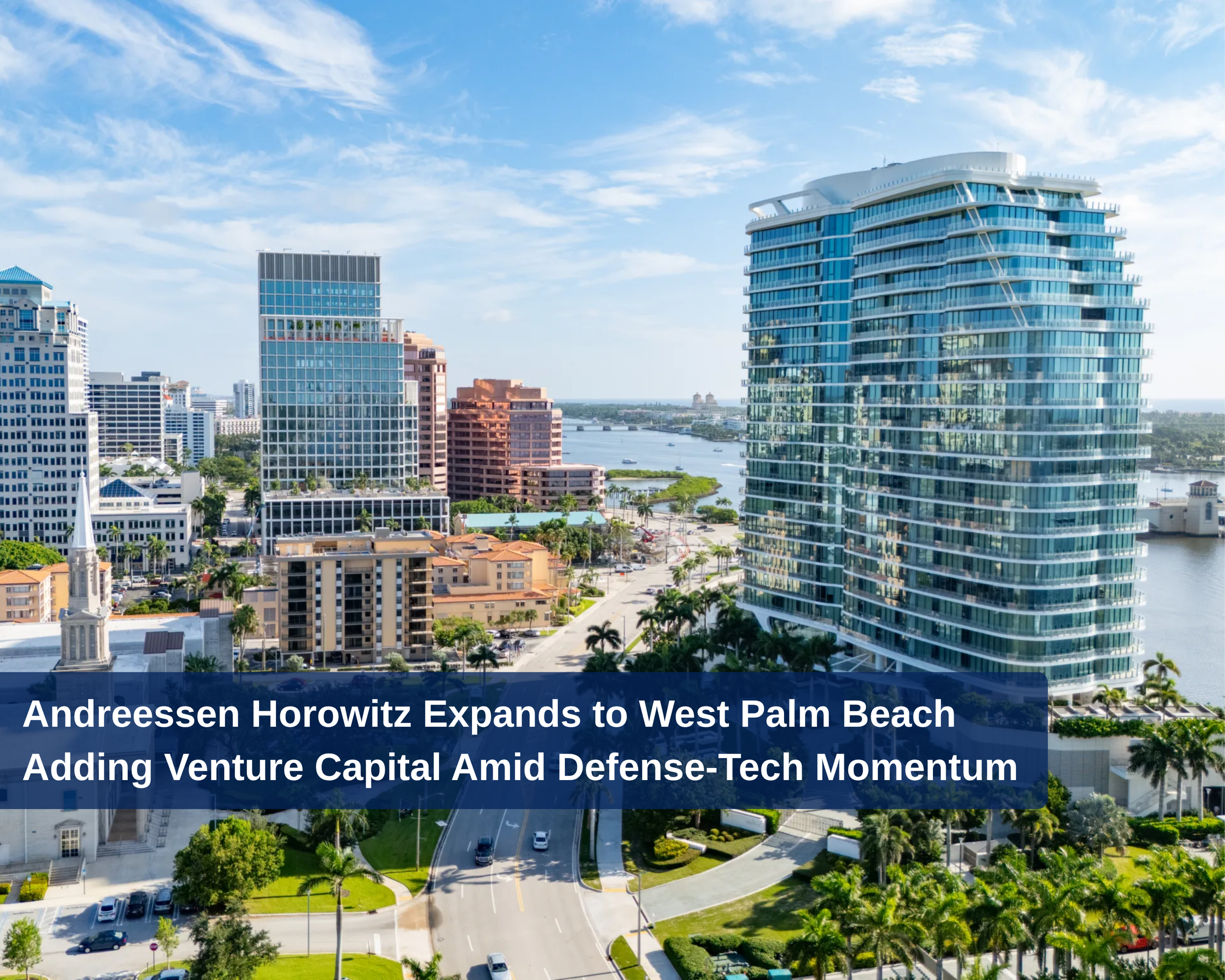
South Florida sits closer to this shift than most regions realize. Cape Canaveral’s Kennedy Space Center and the Space Coast lie 60 miles north. That proximity is not trivia, it is strategic geography. Space tech companies need suppliers, talent, logistics partners, and capital within orbit. Palm Beach County is already absorbing that migration.
Relativity Space, L3Harris, and a growing cluster of aerospace and defense contractors have moved operations or expanded south along the I-95 corridor. The capital, the infrastructure, and the deal flow are converging here such as New World Angels’ launch of Space & Defense Ventures Group. South Florida's tech community does not need to chase the space economy. It needs to recognize it is already inside it.
The window is open. The question is what flies through it.



2150 co-founder Christian Hernandez Gallardo is leaving venture capital to become Executive Chair of Boca Raton-based Blue Frontier, helping the climate-tech company scale manufacturing, expand internationally and capitalize on growing demand for energy-efficient cooling as AI and data centers place new pressure on the electrical grid.