
South Florida Executive Offers Guarded Near-Term Regional Outlook
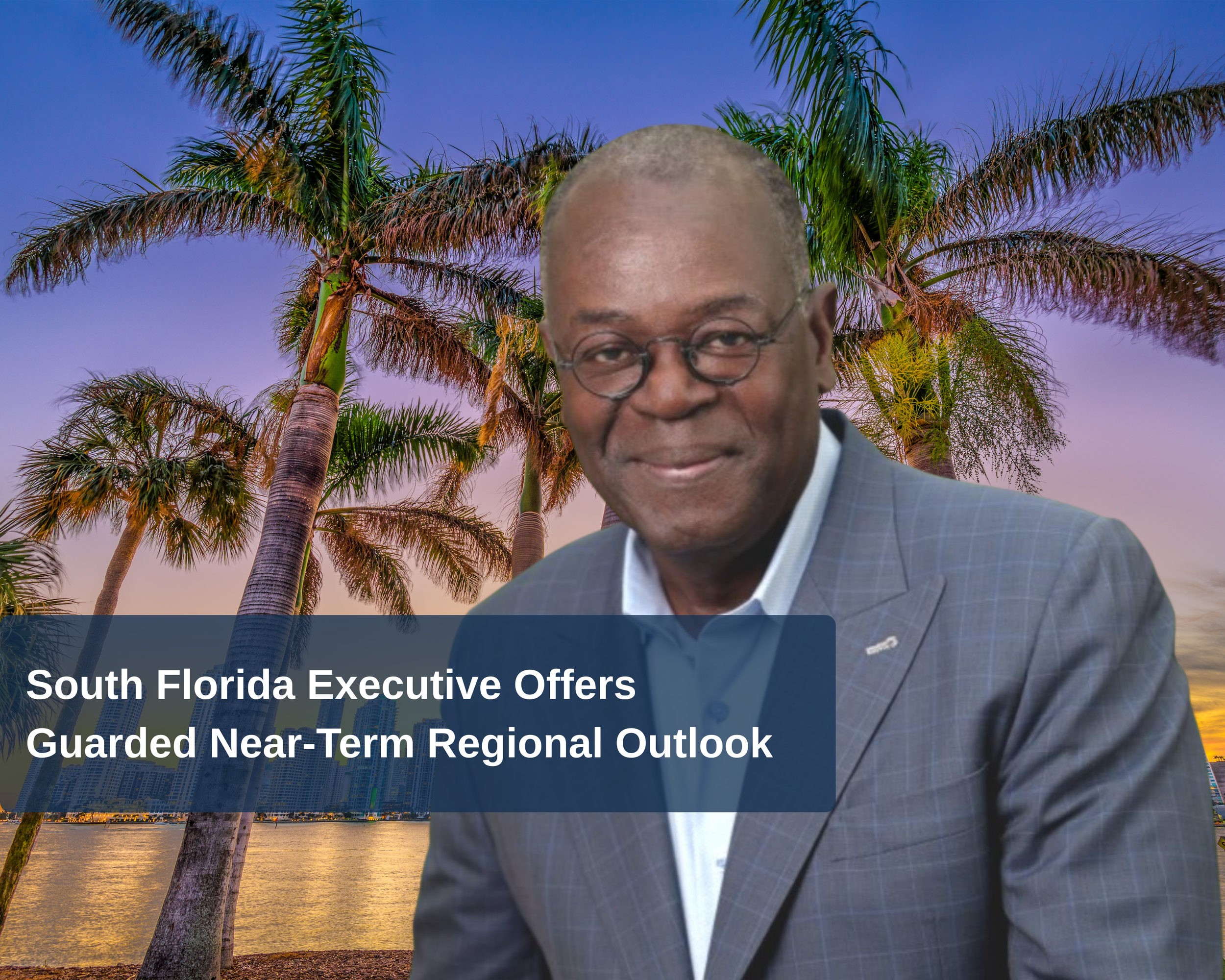
South Florida stands at a pivotal economic moment — one defined as much by uncertainty as by opportunity. According to Rodney Adkins, former IBM senior executive and current board director, the region’s near-term trajectory is promising, yet complex; a blend of technological progress, capital inflows, and both socioeconomic and geopolitical challenges.
Speaking on the current environment, Adkins, a senior leader for IBM’s Boca Raton Personal Computers (PCs) operations before the division moved to North Carolina in the early 90s , characterized South Florida’s economic climate as “positive but uncertain,” noting that growth is unfolding amid volatility. These competing forces, Adkins (a Miami native) said, make forecasting more difficult — but not discouraging.
“There are clear signals of growth, driven by major shifts in technological advancements and the deployment of new business models. At the same time, the crosscurrents from changing consumer consumption patterns, and both socioeconomic and geopolitical challenges create uncertainty,” Adkins, also a recently-retired PayPal board director who currently serves on the boards of United Parcel Service (UPS), W.W. Grainger, Inc., and Avnet (current chairman of the board), said.
A Region Poised for Global Relevance
Despite those uncertainties, Adkins’ long-term outlook for South Florida is decisively optimistic. He believes the region is becoming an increasingly-prominent national and global economic center, particularly as a hub for the Americas.
South Florida’s geographic positioning, cultural connectivity, and expanding professional base give it a natural advantage in cross-border commerce, finance, and innovation. Adkins points specifically to several sectors where the region is beginning to differentiate itself:
Health sciences and life sciences
Financial instruments and digital assets, including crypto
STEM-driven industries and advanced technical jobs
In his view, these sectors align well with global capital flows and demographic shifts that favor regions capable of supporting both innovation and scale. The recent relocation of D-Wave Quantum Inc from Silicon Valley to Boca Raton validates his statement.
“South Florida is evolving into a place that matters not just nationally, but globally — especially as a connector to Latin America and beyond.”
Capital Inflow Is Not Enough — It Must Be Invested Locally
One of Adkins’ most pointed observations concerns how capital behaves once it arrives in South Florida. While the region has benefited from a meaningful influx of investors, private equity, and high-net-worth individuals, Adkins argues that too little of that capital is being deployed locally.
He emphasized the need for a higher percentage of incoming capital to be invested in South Florida-based companies, rather than simply residing there passively.
“Capital location alone doesn’t build an economy. What matters is how much of that capital actually gets invested into local businesses and innovation.”
Adkins stressed that advanced, capable companies are the foundation of a durable regional economy. When these companies take root, they create ecosystems, not just balance sheets — producing a ripple effect that attracts suppliers, complementary industries, talent, and long-term job creation.
This ecosystem effect is especially powerful in health sciences and STEM-related fields, where clustering drives productivity, research activity, and workforce development.
Why the Moment Is More Exciting Than Concerning
While uncertainty remains a defining feature of the current environment, Adkins ultimately frames the present moment as energizing rather than alarming. For him, uncertainty paired with structural opportunity is often where the most meaningful growth occurs.
“Yes, there’s uncertainty — but the region is well positioned. That makes this moment more exciting than concerning.”
His perspective reflects decades of experience navigating technological shifts, global markets, and corporate transformations. The same forces that complicate the outlook — rapid innovation, geopolitical realignment, new financial instruments — are also the forces creating opportunity for regions agile enough to adapt.
Curiosity as an Economic and Career Advantage
Adkins’ views on South Florida mirror a broader philosophy outlined in his book, Curiosity Redefines the Limits. The title, he explains, was inspired by the power of curiosity — particularly intellectual curiosity — as a driver of growth, adaptability, and long-term success.
The book introduces a career life-cycle model, outlining how individuals should think about:
Early career development
Mid-career reinvention
Late-career leadership
And “active retirement” — a phase focused on impact, mentorship, and strategic engagement
This framework parallels his economic outlook: regions, like careers, must continuously evolve, reinvest, and stay curious to remain relevant.
The Bigger Picture
Taken together, Adkins’ assessment offers a clear takeaway for investors, policymakers, and business leaders: South Florida’s future is promising, but not automatic. Growth will depend on whether capital is activated locally, whether ecosystems are intentionally built, and whether the region leans into its role as a global connector for innovation, finance, and science.
Uncertainty may define the present — but according to Adkins, curiosity, commitment, and local investment will define what comes next.

YouTube sensation IShowSpeed, also known as Darren Watkins Jr., has reportedly invested $10.75 million in a Miami-Dade warehouse to establish a dedicated content creation and production studio. The 26,600-square-foot property represents a major step in the creator's expansion from livestreaming into a larger media enterprise. Miami real estate broker Jordan Karp represented IShowSpeed in the transaction. The investment highlights South Florida's growing role in the creator economy, connecting digital entertainment, technology, commercial real estate, and entrepreneurship.