
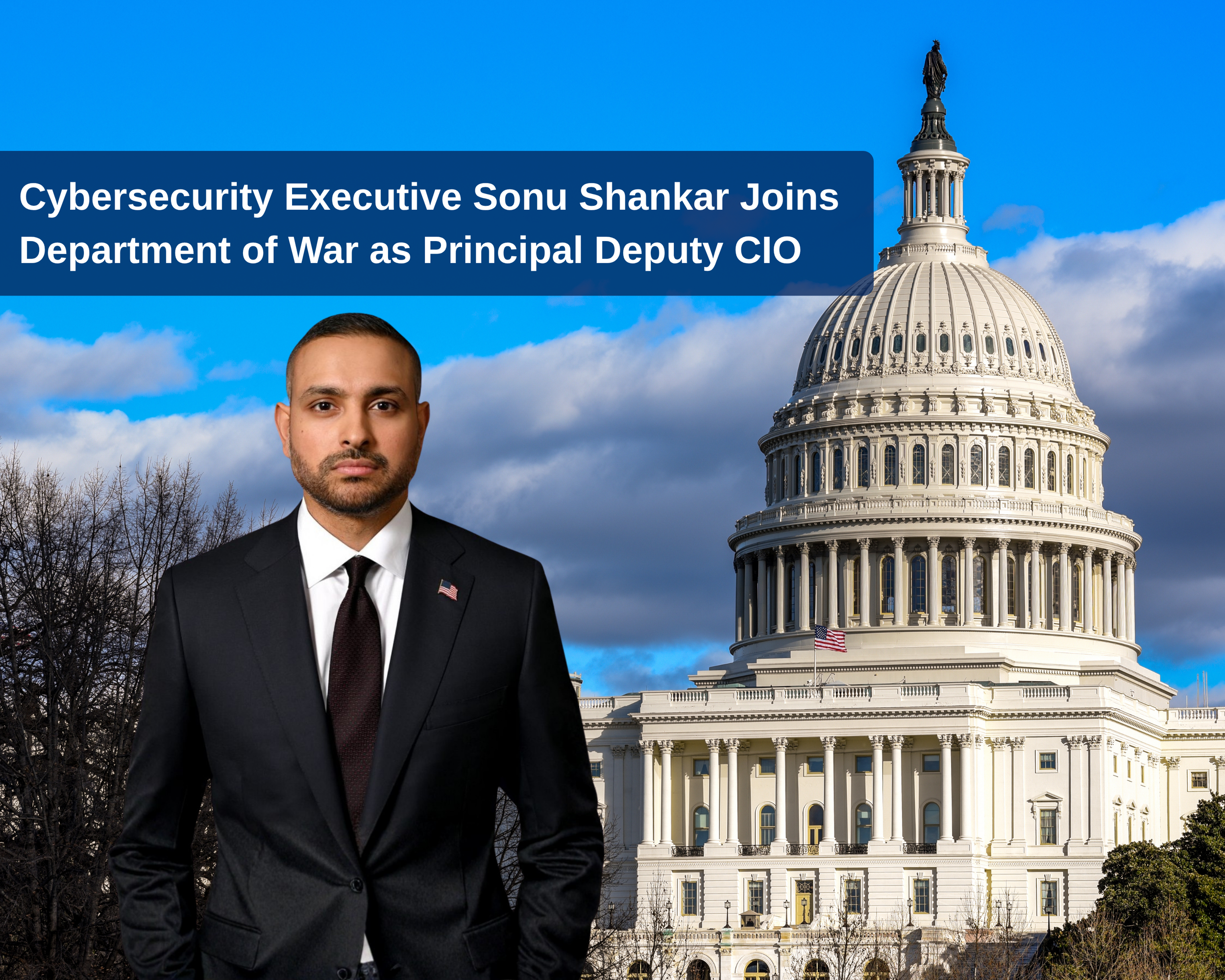
The U.S. Department of War is adding another private-sector technology executive to its senior leadership as it works to modernize its massive technology infrastructure and deepen its engagement with the commercial innovation ecosystem.
Cybersecurity executive Sonu Shankar has received a presidential appointment to serve as the Department's new Principal Deputy Chief Information Officer, according to an announcement from the Office of the Department of War Chief Information Officer.
In the role, Shankar will work alongside Chief Information Officer Kirsten Davies to help advance the Department's information technology, cybersecurity and digital modernization priorities.
His appointment brings an executive with more than 15 years of experience across cybersecurity research, engineering, product development and corporate leadership into one of the federal government's most complex technology environments.
It also comes as the Department is increasingly looking toward the commercial technology sector for solutions to national security challenges.
From Commercial Cybersecurity to the Pentagon
Shankar's career has crossed both government research and some of the technology industry's best-known cybersecurity companies. He began his security career as a researcher at Los Alamos National Laboratory before moving into the private sector, where his experience included positions at Cisco, Box and Arctic Wolf. Most recently, Shankar rose through the leadership ranks at Phosphorus Cybersecurity, a company focused on securing the extended Internet of Things, or xIoT.
Shankar served in several leadership positions at Phosphorus, including vice president of product management, chief strategy officer and chief product officer. In August 2025, he was named president and chief operating officer, overseeing areas including product engineering, sales, marketing and corporate development.
Industrial cybersecurity company Dragos acquired Phosphorus in June 2026, bringing the company's technology into a broader operational technology cybersecurity platform. Just months later, Shankar is moving from commercial cybersecurity into senior technology leadership at the Pentagon.
Securing an Increasingly Connected Defense Environment
Shankar's experience with connected devices could be particularly relevant to the Department's evolving technology strategy. The modern technology environment extends far beyond traditional computers and enterprise networks. Connected sensors, operational technology, communications equipment, cameras, industrial systems and other cyber-physical devices create an increasingly complex attack surface.
At Phosphorus, Shankar's work centered heavily on identifying, managing and securing those devices, including risks created by default credentials, outdated firmware and insecure configurations. Those challenges take on additional significance in national security environments, where networks increasingly connect physical and digital systems.
As Principal Deputy CIO, Shankar joins an organization whose responsibilities span cybersecurity, communications, information systems, digital modernization and the technology infrastructure supporting data and artificial intelligence across the Department. His commercial product background also provides another example of private-sector technology expertise moving directly into government leadership.
Part of a Broader Commercial Technology Push
Shankar's appointment comes as the Department of War is making a broader effort to connect national defense priorities with technologies being developed outside the traditional defense industrial base.
That shift was visible in August when the Department launched the Golden Dome for America Ecosystem Hub, a digital gateway designed to connect startups, commercial technology companies, venture capital firms, universities and research institutions with the developing Golden Dome missile defense initiative.
The Hub provides innovators with greater visibility into Golden Dome's unclassified capability gaps and creates a pathway for companies to introduce technologies and concepts directly to the program. The two developments are not formally connected, and the Department has not indicated that Shankar's appointment is specifically related to Golden Dome.
However, they illustrate a similar direction: bringing more commercial technology, private-sector expertise and nontraditional innovators into the national defense ecosystem.
For companies developing cybersecurity, artificial intelligence, autonomous systems, communications technologies, advanced sensing and other dual-use technologies, that evolution could create new opportunities to engage with federal defense programs.
Why South Florida's Tech Community Should Pay Attention
The Department's evolving technology strategy is particularly relevant for South Florida, where the defense-tech ecosystem is rapidly expanding across autonomous systems, artificial intelligence, cybersecurity, advanced manufacturing and other dual-use technologies.
One of the clearest examples is West Palm Beach-based Ondas Inc. As Venture Tech Chronicle recently reported, Ondas is rapidly building a global autonomous and defense technology platform from its South Florida headquarters through acquisitions, investments and major military contracts.
The company has expanded across drones, counter-drone technologies, intelligence and surveillance, battlefield software, autonomous ground systems and advanced manufacturing. Its U.S.-based defense prime contractor, Mistral, also recently received a $50 million U.S. Army order for tactical Lethal Unmanned Systems, bringing its awards under the broader Army program to more than $240 million.
Ondas is not alone. The arrival and expansion of companies working across autonomous systems, cybersecurity, artificial intelligence and other defense-related technologies are strengthening South Florida's position within the broader national defense innovation ecosystem.
But the technology priorities his office will help oversee, cybersecurity, digital infrastructure, communications, data and emerging technology, increasingly overlap with capabilities being developed by companies across the region.
Combined with Department initiatives designed to create more pathways for commercial companies to participate in national security programs, including the recently launched Golden Dome for America Ecosystem Hub, the direction could be significant for South Florida founders, investors and researchers.
As the lines between commercial technology and defense technology continue to blur, understanding who is shaping technology strategy inside the Department, and the types of technologies they prioritize, could become increasingly important for South Florida's growing defense-tech community.
A Different Kind of Defense-Tech Leadership
Perhaps the most notable aspect of Shankar's appointment is the path he took to the Pentagon. He isn't arriving solely from the traditional defense contracting establishment. His career includes cybersecurity research, Silicon Valley technology companies, venture-backed cybersecurity businesses, product development and scaling an emerging technology company through acquisition.
That experience puts someone familiar with the realities of building and commercializing cybersecurity technology into a leadership position helping shape how one of the world's largest organizations approaches technology. For South Florida's growing community of cybersecurity and defense-tech companies, Shankar is another technology leader worth watching.
And alongside initiatives such as the Golden Dome Ecosystem Hub, his appointment provides another indication that the line separating commercial technology innovation from national defense is becoming increasingly thin.




Davie-based ZEO ScientifiX is preparing to expand into Georgia and Tennessee following new regenerative medicine legislation. Operating from Nova Southeastern University, the biotechnology company's growth strategy highlights South Florida's expanding life sciences ecosystem and its growing national influence.