Golden Dome Wants Startups, Tech Companies and Investors. Is South Florida ready?
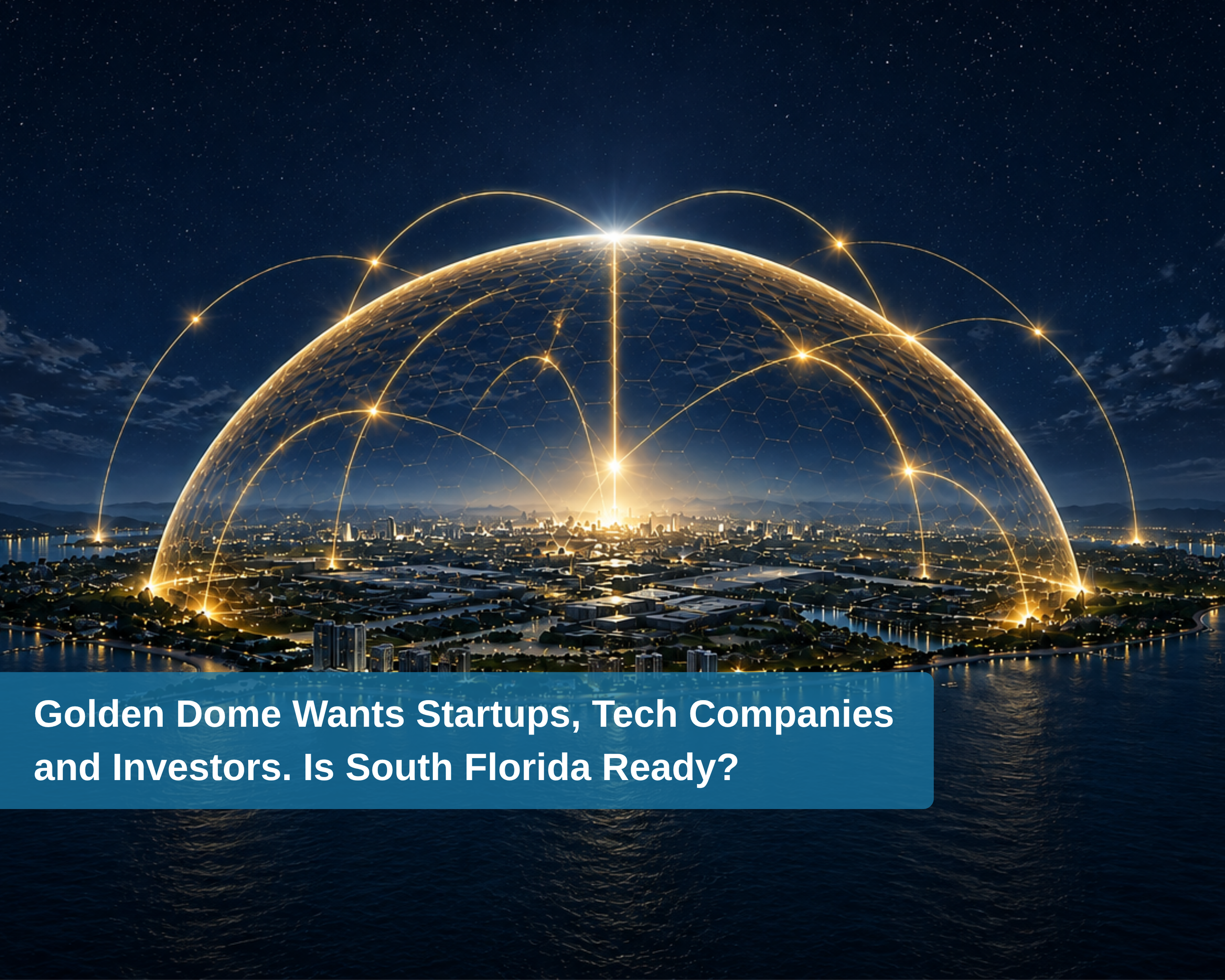
On Aug. 11, the U.S. Department of War launched a new digital gateway designed to connect one of the country's most ambitious defense programs with an unusually broad group of innovators, including startups, commercial technology companies, venture capital firms, universities and research laboratories.
The Golden Dome for America Ecosystem Hub is intended to give companies outside the traditional defense contracting establishment a more direct way to introduce technologies that could contribute to the nation's developing missile defense architecture.
For South Florida's rapidly expanding technology and defense-tech ecosystem, that could create a significant new opportunity.
Why South Florida Companies Should Pay Attention
What makes the Ecosystem Hub particularly notable is its effort to lower the barrier between commercial innovation and federal defense procurement. Companies do not necessarily need to begin as traditional defense contractors. The government is explicitly seeking technologies developed in the commercial market that could be adapted to Golden Dome's mission.
Through the Hub, companies can gain unclassified visibility into capability gaps identified by the Golden Dome program, potentially allowing founders, researchers and investors to evaluate whether existing technologies, or technologies already under development, could address those needs.
Companies can compare their existing products, services and capabilities with the technological needs identified by the Golden Dome program. For South Florida's rapidly growing tech ecosystem, that could provide access to a significant new federal market.
The region has growing capabilities across artificial intelligence, cybersecurity, autonomous systems, aviation, advanced sensing, data analytics, engineering and advanced manufacturing, areas that could overlap with portions of Golden Dome's broader technology requirements. This creates an opportunity for companies that may not traditionally consider themselves part of the defense industry to explore whether their technologies could have national security applications.
If South Florida companies ultimately win Golden Dome-related work, the resulting contracts could increase demand for engineers, software developers, cybersecurity professionals, researchers, manufacturing specialists and other highly skilled workers.
TJ Villamil, President of Business Development at eMerge Americas, sees the Golden Dome initiative as a potentially significant shift in how commercial technology companies and regional innovation ecosystems can participate in national defense efforts.
“For decades homeland missile defense was a closed market that ran through a handful of primes. Golden Dome breaks that model,” Villamil said. “The Department of War stood up a public front door at hub.goldendome.mil and invited commercial companies, universities and investors to see unclassified demand signals and respond directly. That is built for a region like ours.”
Villamil believes that South Florida already possesses many of the pieces needed to take advantage of that opening. “ South Florida has the commands, the university research, the production floor and the capital,” he shared. “The goal is not to make Miami another Silicon Valley for defense. It is to make South Florida the capital and commercial front door of a statewide Florida defense network.”
South Florida's Growing Defense-Tech Ecosystem
South Florida is already seeing increased growth in defense technology. In particular, Palm Beach County and Miami-Dade County have attracted industry leaders to establish a presence in the region.
This year alone, several major defense-tech companies have either relocated to South Florida or opened divisions in the region. Notably,Ondas, Inc., an AI-powered autonomous and defense systems company,relocated its headquarters from Boston to West Palm Beach in January 2026. Soon after,Palantir also announced that its headquarters moved to Aventura.
Further indicating the strength of South Florida's tech ecosystem and the growing presence of defense-tech companies in the region,Blue Ops, the maritime division ofRed Cat Holdings, established an innovation facility in Palm Beach County focused on autonomous surface vessels in February 2026.
The continued growth of the defense-tech industry creates another opportunity for South Florida to expand its presence in a sector traditionally concentrated in other parts of the country.
A New Opportunity for Investors
Golden Dome's potential impact on South Florida extends beyond technology companies. The Department of War has specifically identified venture capital firms among the groups it wants participating in the Ecosystem Hub, creating another potential connection between private investment and federal technology priorities.
For South Florida investors, visibility into Golden Dome's technology needs could provide another lens for evaluating startups developing dual-use technologies, products originally developed for commercial markets that may also have national-security applications.
That could create a reinforcing cycle within the region's emerging defense-tech ecosystem: investors fund promising technologies, startups gain access to new federal customers, and successful companies attract additional capital and talent to South Florida.
A Role for South Florida’s Universities and Researchers
Golden Dome could also create new opportunities for South Florida’s universities, research institutions, faculty, and students. The Ecosystem Hub is specifically designed to engage academic institutions and research laboratories alongside commercial technology companies, startups, and investors, creating another pathway for university-developed technologies to address national defense needs.
Florida universities are already demonstrating how academic research can enter the defense-tech ecosystem. Florida State University has been selected as an awardee under the Missile Defense Agency’s Scalable Homeland Innovative Enterprise Layered Defense (SHIELD) program, making the university eligible to compete for future task orders supporting homeland missile defense initiatives.
For South Florida institutions, Golden Dome could provide another opportunity to connect existing research in areas such as artificial intelligence, cybersecurity, autonomous systems, engineering, advanced sensing, data science, aviation, and other emerging technologies with federal defense priorities.
The opportunity could also extend beyond research. Universities could collaborate with private-sector companies on new technologies, support the commercialization of university-developed intellectual property, and potentially launch startups around technologies with both commercial and national security applications.
Greater participation in defense technology could also benefit South Florida’s talent pipeline. Students could gain exposure to careers in national security and defense tech while local companies gain access to graduates with specialized technical skills.
As South Florida works to retain more of the talent graduating from its colleges and universities, a growing defense-tech sector could provide another pathway for students to build high-skilled technology careers without leaving the region.
From South Florida Innovation to National Defense
Golden Dome's broad technology needs could create opportunities across advanced sensing, artificial intelligence, data analytics, cybersecurity, communications, autonomous systems, space technologies and advanced manufacturing. For South Florida companies, the opportunity may not require developing something specifically for missile defense. Technologies already being built for commercial industries could have dual-use applications that address Golden Dome capability needs.
Companies, startups, universities, researchers and other interested organizations can begin by registering through the Golden Dome for America Ecosystem Hub. Once registered, participants can introduce their capabilities, upload concepts and designs, and gain greater visibility into the program's unclassified capability gaps.
Registration, however, does not guarantee funding or a federal contract. Companies pursuing specific opportunities may need to navigate additional procurement, cybersecurity, security, export control or other federal requirements. For startups new to defense contracting, partnerships with established contractors, universities or research institutions could provide another pathway into the market.
Golden Dome arrives at a pivotal time for South Florida. The region is attracting defense-tech companies, building capabilities in AI and autonomous systems, expanding its research ecosystem and attracting private capital. The Ecosystem Hub now gives those companies, investors and researchers another potential pathway into the federal defense market.
For South Florida's innovators, the question may no longer be whether they consider themselves part of the defense industry, but whether a technology they are already building could help solve a national security challenge.


Florida Atlantic University is leading a $5.7 million initiative to improve literacy in Broward County schools while preparing educators to use artificial intelligence responsibly. Through LEAP-AI, FAU and its partners aim to strengthen teacher training, expand career pathways, and build South Florida's future workforce.