
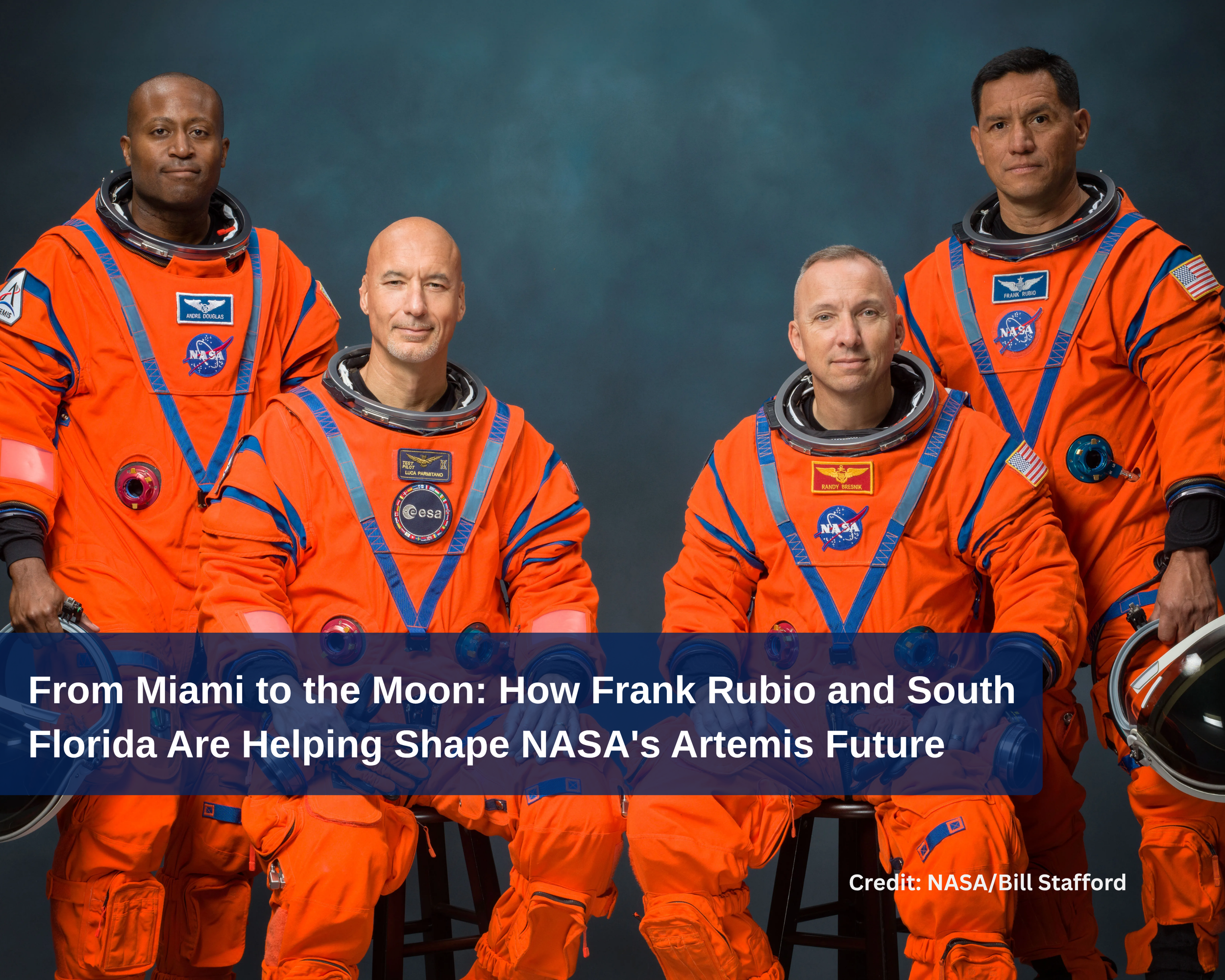
When NASA unveiled the crew for Artemis III this week, much of the attention focused on the mission itself: a complex, first-of-its-kind test flight that will bring together NASA, SpaceX, Blue Origin, and international partners in preparation for humanity’s return to the lunar surface.
But for South Florida, the announcement carried a more personal significance.
Among the four astronauts selected for the mission is Frank Rubio, a Miami-area high school graduate, Army colonel, physician, and record-setting astronaut whose journey from South Florida classrooms to the forefront of lunar exploration represents one of the region’s strongest connections yet to America’s new space age.
As Florida continues to emerge as a global hub for innovation, advanced manufacturing, aerospace, defense technology, and venture-backed growth, Rubio’s selection underscores a broader reality: the Sunshine State’s role in the Artemis program extends far beyond the launch pad.
“Today we take another bold step in humanity’s return to the Moon, building on the extraordinary foundation laid by the Artemis II astronauts,” said NASA Administrator Jared Isaacman. “Their achievements reignited global excitement for exploration, and now they pass the torch to the Artemis III team, Randy, Luca, Frank, and Andre. Artemis III will demonstrate the power of American innovation and international partnership as we test complex rendezvous and docking operations and advance the technologies that will one day carry us deeper into the solar system
A New Chapter for Artemis
NASA's Artemis program is designed to return humans to the Moon for the first time since the Apollo era while laying the foundation for future crewed missions to Mars.
Unlike previous Artemis missions, Artemis III will serve as an ambitious orbital proving ground for the technologies and partnerships required for sustained lunar exploration.
The mission will launch aboard NASA’s Space Launch System (SLS) rocket from Kennedy Space Center and place the Orion spacecraft into Earth orbit. Once there, the crew will conduct a series of rendezvous and docking operations with lunar lander test vehicles being developed by Blue Origin and SpaceX.
The mission is expected to involve one of the most sophisticated multi-launch campaigns ever attempted, requiring coordination between government and commercial spaceflight systems while validating the hardware, software, communications, and operational procedures that will support future lunar missions.
NASA announced the Artemis III prime crew as:
NASA astronaut Randy Bresnik, commander
ESA (European Space Agency) astronaut Luca Parmitano, pilot
NASA astronaut Andre Douglas, mission specialist
NASA astronaut Frank Rubio, mission specialist
The mission is currently targeted for 2027.
Miami's Astronaut Frank Rubio
For South Florida residents, Frank Rubio's story stands out.
A graduate of Miami Sunset Senior High School, Rubio represents a rare local connection to one of NASA’s most important programs in decades.
Selected as a NASA astronaut in 2017, Rubio brings a unique combination of military, medical, and aviation experience. He graduated from the U.S. Military Academy at West Point, earned his medical degree from the Uniformed Services University of the Health Sciences, and served for more than two decades in the U.S. Army as both a physician and helicopter pilot.
His first trip to space came in 2022 aboard a Russian Soyuz spacecraft bound for the International Space Station.
What was intended to be a routine six-month mission became a historic achievement.
Following technical issues with the spacecraft that was originally scheduled to bring him home, Rubio remained aboard the station for 371 consecutive days (September 21, 2022 - September 27, 2023), setting the American record for the longest single-duration spaceflight in history.
Now, he will help lead NASA’s next era of exploration.
For students across Miami-Dade, Broward, and Palm Beach counties, Rubio's path offers a powerful reminder that global achievements often begin with local opportunities.
South Florida's Hidden Connection to Artemis
Frank Rubio isn't the only South Florida link to NASA's lunar ambitions.
As VTC recently reported, the Aquarius Reef Base, an underwater research habitat operated by Florida International University in the Florida Keys, has played a role in preparing astronauts for future deep-space missions. Through NASA's NEEMO program, astronauts train in Aquarius to simulate the isolation, teamwork, and operational challenges they'll face beyond Earth.
The facility has hosted several astronauts connected to the Artemis program, highlighting how South Florida's contributions to lunar exploration extend far beyond the launch pads of the Space Coast. From Miami classrooms that helped shape Rubio's journey to an underwater laboratory helping prepare future explorers, the region is quietly playing a role in humanity's return to the Moon.
This version is about half the length, flows better within the article, and naturally references your previous Venture Tech Chronicle reporting.
Florida's Expanding Role in the Space Economy
While Artemis launches from Florida's Space Coast, the economic impact of the program increasingly reaches every corner of the state.
For decades, Florida's identity in space was centered around launch operations at Kennedy Space Center and Cape Canaveral. Today, however, the state's aerospace ecosystem is becoming more interconnected.
South Florida is attracting aerospace suppliers, advanced manufacturers, defense technology firms, drone companies, artificial intelligence startups, and investors seeking opportunities at the intersection of national security and emerging technologies.
The region's universities, including Florida Atlantic University, Florida International University, and the University of Miami, continue expanding research programs in engineering, autonomous systems, robotics, and advanced computing.
At the same time, the state's growing reputation as "Wall Street South" is bringing capital and executive talent that could further accelerate investment into aerospace and defense innovation.
The result is a statewide innovation economy where launches may occur on the Space Coast, but the talent, capital, and technologies supporting those missions increasingly originate throughout Florida.
The Commercial Space Era Arrives
Artemis III also highlights a fundamental shift in how space exploration is conducted.
Rather than relying solely on government-built systems, NASA is partnering closely with commercial providers including SpaceX and Blue Origin, both of which are developing lunar lander technologies that will be tested during the mission.
The approach reflects a broader trend reshaping the global aerospace industry: public-private partnerships that leverage government expertise while accelerating innovation through commercial competition.
For Florida, where many of these companies maintain significant operations, the economic implications are substantial.
Each Artemis mission supports thousands of jobs across engineering, manufacturing, software development, logistics, communications, and research.
As NASA looks toward future lunar operations and eventual missions to Mars, Florida stands positioned not only as America's launch site, but increasingly as a center for the technologies, companies, and talent that will define the next generation of exploration.
More Than a Mission
For South Florida, Frank Rubio's selection represents more than an astronaut assignment.
It is a reminder that the region's future extends beyond finance, real estate, tourism, and healthcare. It also lies in science, engineering, advanced technology, and exploration.
When Artemis III launches from Kennedy Space Center, millions of people around the world will watch another chapter in humanity's journey beyond Earth.
Among them will be students in Miami classrooms, entrepreneurs across South Florida's growing innovation ecosystem, and future engineers who may see in Rubio's story a path of their own.
The mission may begin on Florida's Space Coast, but one of its astronauts began his journey much farther south: right here in Miami.


The activation of Florida's first statewide quantum-safe network segment, new investments in research and workforce development, and the growing presence of quantum technology companies took center stage at Quantum Beach 2026, where more than 400 business, government and research leaders gathered Oct. 22 in West Palm Beach.