

How FAU's Hacking for Defense Program Signals South Florida's Growing Role in National Innovation
For years, South Florida has been recognized for its strengths in tourism, real estate, healthcare, and financial services. Today, another identity is taking shape, one built on artificial intelligence, quantum computing, cybersecurity, robotics, and defense technology.
Florida Atlantic University's successful completion of its inaugural Hacking for Defense (H4D) course is another milestone in that transformation.
While the program may appear to be a university classroom initiative on the surface, it represents something much larger: South Florida's growing participation in the nation's innovation ecosystem, where universities, entrepreneurs, industry leaders, and the U.S. Department of Defense, also referred to as the Department of War by our current administration, collaborate to solve complex, real-world challenges.
A Different Kind of Classroom
Unlike traditional engineering or computer science courses, Hacking for Defense places students directly alongside military organizations to address operational problems currently facing the Department of Defense and the Intelligence Community.
Originally developed at Stanford University and now offered at leading universities across the country, H4D combines entrepreneurship, customer discovery, engineering, and rapid prototyping into a semester-long innovation sprint.
Students don't simply complete assignments, they interview military operators, validate problems with end users, and develop minimum viable products that have the potential to transition into real-world deployment.
It's experiential learning with national impact.
As Hari Kalva, chair of FAU's College of Engineering and Computer Science and the faculty lead for the program, explains, Hacking for Defense represents the next evolution of the university's long-standing collaboration with the federal government.
"FAU has a long-standing and substantial research relationship with the Department of War, supported by major DoW-funded research projects that have involved faculty, graduate students and undergraduate students for many years," said Kalva.
"What Hacking for Defense adds is a new classroom-based pathway that brings mission-driven problem solving, customer discovery and business development training directly into undergraduate project work. Our students are not just solving textbook problems. They are working with operational sponsors, interviewing the people closest to the mission, and building prototypes that can be evaluated by DoW partners. This is an important extension of FAU's broader national defense research enterprise and a powerful way to prepare mission-minded engineering and computer science talent."
That philosophy is evident throughout the inaugural cohort, where multidisciplinary student teams partnered directly with military organizations to develop solutions for challenges spanning autonomous systems, human performance, advanced training, and artificial intelligence.
Solving Problems That Matter
FAU's first H4D cohort partnered with organizations including the U.S. Army Corps of Engineers, the U.S. Army Aeromedical Research Laboratory, the Army Combat Capabilities Development Command Soldier Center, and the 2nd Cavalry Regiment stationed in Germany.
Each multidisciplinary team tackled a unique challenge.
One team developed AI-assisted software to improve physical training recommendations for soldiers operating in diverse environments. Another explored continuous cognitive monitoring technologies designed to help identify pilot fatigue before performance declines.
Students also worked on advanced haptic systems to improve combat medic training and autonomous drone technologies capable of multi-sensor data fusion.
These were not hypothetical exercises.
Throughout the semester, students conducted more than 80 customer discovery interviews with military personnel, traveled to military installations, attended defense innovation events, and refined their solutions based on direct operational feedback.
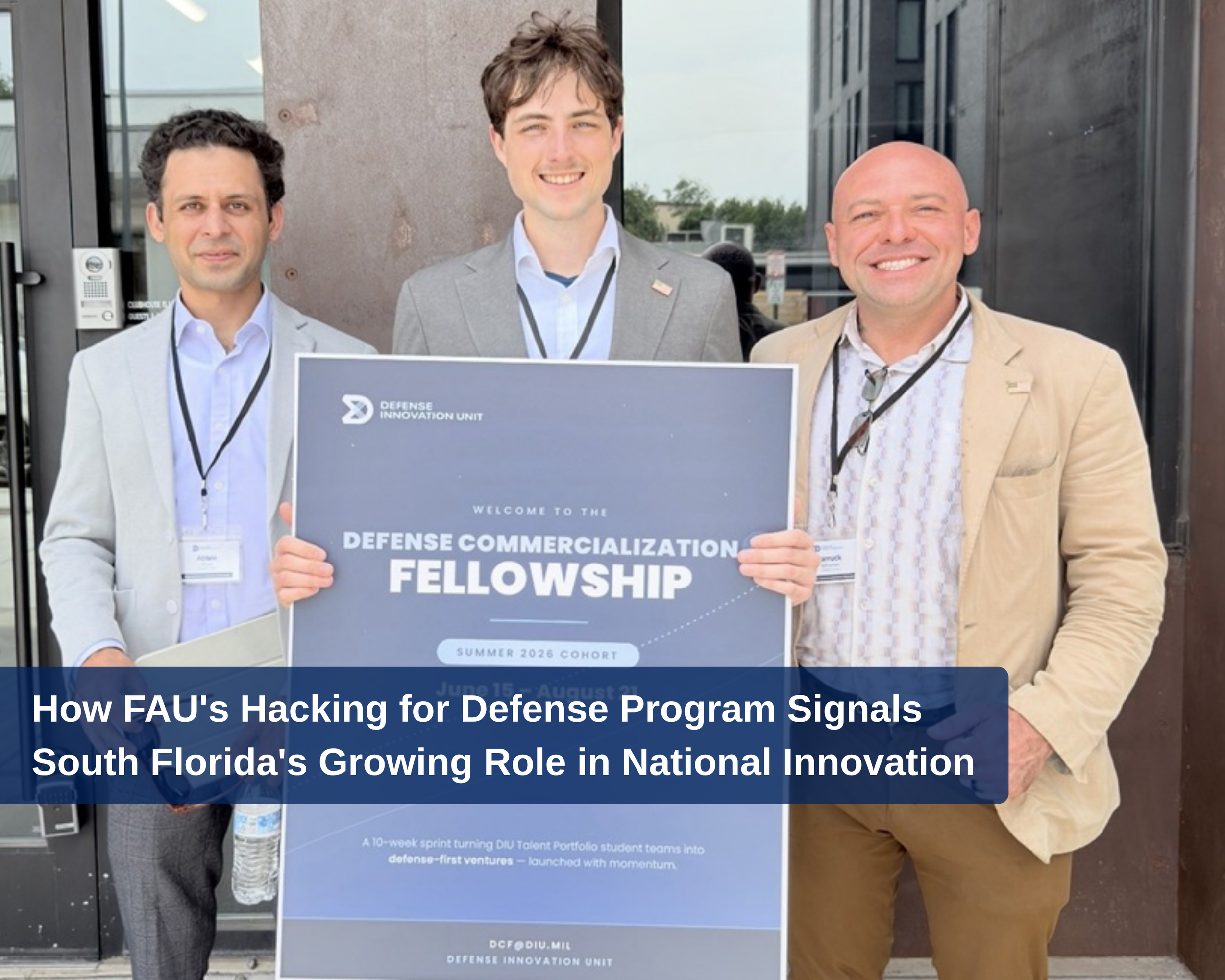
Perhaps the strongest validation came when Project Firefly, an autonomous drone initiative developed for the U.S. Army Corps of Engineers, was selected for the Defense Innovation Unit's Commercialization Fellowship, a prestigious program designed to help promising technologies transition beyond the university environment and toward real deployment.
South Florida's Innovation Ecosystem Is Maturing
Viewed independently, Hacking for Defense is an impressive academic achievement. Viewed within the context of South Florida's rapidly evolving technology ecosystem, however, it represents something much larger.
Across the region, momentum is building around artificial intelligence, quantum computing, cybersecurity, robotics, autonomous systems, and advanced research partnerships. Florida Atlantic University continues expanding its leadership in AI, engineering, and quantum research, while D-Wave Quantum's growing presence in Boca Raton is bringing commercial quantum computing closer to businesses, researchers, and enterprise partners.
At the same time, technology companies, startups, research institutions, and government agencies are increasingly choosing South Florida as a place to develop, test, and commercialize emerging technologies with applications spanning healthcare, logistics, aerospace, manufacturing, financial services, and national security.
The convergence of these disciplines is reshaping nearly every industry. Technologies initially developed to solve national security challenges are increasingly finding commercial applications, from predictive analytics and autonomous systems to advanced sensing, resilient communications, and next-generation computing.
Programs like Hacking for Defense accelerate that cycle of innovation by exposing students to real-world operational challenges while connecting government agencies with entrepreneurial thinking and rapid development methodologies more commonly associated with startups. The result is faster collaboration, stronger technology transfer, and a workforce prepared to move ideas from research laboratories into commercial products and real-world solutions.
These developments are not isolated announcements. Together, they signal the emergence of a connected innovation ecosystem where universities, startups, Fortune 500 companies, investors, and government partners collaborate to transform breakthrough research into technologies that strengthen both economic growth and national security.
As this ecosystem continues to mature, South Florida is positioning itself not simply as a consumer of innovation, but as a region where the next generation of transformative technologies is being imagined, developed, commercialized, and deployed.
As innovation increasingly defines regional competitiveness, FAU's successful launch of Hacking for Defense is more than a university milestone.
It is another signal that South Florida is becoming one of the country's emerging centers for deep technology, applied research, and innovation with global impact.




2150 co-founder Christian Hernandez Gallardo is leaving venture capital to become Executive Chair of Boca Raton-based Blue Frontier, helping the climate-tech company scale manufacturing, expand internationally and capitalize on growing demand for energy-efficient cooling as AI and data centers place new pressure on the electrical grid.